
EXPERIMENTAL WRITING AND TRANSMEDIA THEORY
FOR ARTISTS, SCHOLARS, AND COMMUNITIES
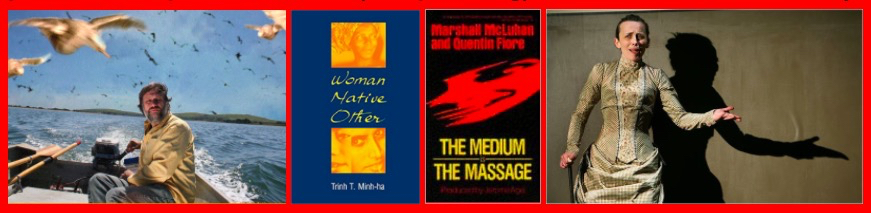
ENGL 6780 • Wed 2:30-4:25 pm • 110 Rockefeller Hall • 3 credits • No prerequisites
Prof. Jon McKenzie • jvm62@cornell.edu • Office: Tues 2:00-4:00 • 104 Klarman Hall 

Course Overview

Description: How does one “do theory” inside and outside the book, and inside and outside the academy? This course explores experimental writing and transmedia theory within the context of community engagement. Materials include: Artaud’s “To Be Done with the Judgment of God” (text and radio drama), Debord’s Society of the Spectacle (text and film), Lesy’s Wisconsin Death Trip (text), Marsh’s Wisconsin Death Trip (film), McLuhan/Fiore’s The Medium is the Massage (text and audio), Ronell’s The Telephone Book (text), Reines’s Telephone (play); Trinh T. Minh-Ha’s Woman, Native, Other (text); and the films Barison and Ross’ The Ister, Boutang’s Deleuze from A to Z, and Zizek and Fiennes’s The Pervert’s Guide To Cinema. Students will do theory and make media, including texts, PechaKuchas, and websites. No prior media experience needed.

While many of these texts are highly experimental and theoretical, our goal will be to translate or transmediate them for both other artists, scholars, and public communities, in particular at-risk youth at the George Junior Republic School, where a Cornell undergraduate student has helped to create Poetic Justice, two poetry clubs interested in transmedia poetry. We shall thus explore related book and media forms, such as theory comics, graphic novels, PechaKuchas, and RSAnimates as ways to experiment with writing and theory for both specialized and nonspecialized practitioners. 

The course combines creative and critical skills in seminar, studio, and lab activities, as well as a local field trip. As experimental writing and transmedia theory are designed as well as composed, students will learn a series of design frames to develop methods and languages for analyzing, creating, and sharing their work with others. Students will also be encouraged to develop teaching philosophies and digital pedagogies connecting community engagement and their own work while creating an online professional website. The overall goal is to contribute to the democratization of digitality in academia and community life. 

Learning outcomes


Experimental writing techniques
Critical media analysis
Community-engaged practice
Collaborative problem-solving

Information and experience design
Storytelling and visualization
Transmedia production skills
Online portfolio of work

Course Requirements

Projects and design frames: Over the term, students complete two projects and a series of design exercises that introduce three design frames that can be used both to analyze and generate experimental writing and transmedia theory:

CAT (conceptual, aesthetic, technical)
UX (user experience: experience design, information architecture, information design)
DT (design thinking’s constraints of human desirability, technical feasibility, economic viability)

In Project 1, students will analyze a work of experimental writing or transmedia theory and translate that work for a public audience using different media. For Project 2, students produce individual projects based on their own work or interests (eg, translate a paper into a media campaign, a method into a service, a theory into an app); or participate in a capstone outreach project. Our goal is producing quality work sharable with others.

Exercises and thumbnails: Exercises grow out of daily readings and materials and for each reading, students write conceptual thumbnails summarizing main arguments, defining critical concepts, and posing critical questions.

Design blogs/journals: Capture and process your learning and its application to the world around you. Use the WP blog function to post content weekly on a publicly visible page.

Conceptual: notes from class and readings, and links to relevant articles, topics, etc.
Aesthetic: work related to design exercises: sketches, mood boards, maps
Technical : work related to software, hardware
Design in Everyday Life: illustrated reflections on media and community in the world around you, using CAT, UX, and DT design frames.

Evaluation 

The final grade breakdown is 33% each for Project 1, Project 2, and Participation. Exercises and thumbnails, along with discussion, attendance, comprise the Participation component of the class. Two absences may result in final grade reduction; three in failure. Students will be asked to engage in studio crits and help evaluate presentations.

Academic Integrity

Each student in this course is expected to abide by the Cornell University Code of Academic Integrity. Any work submitted by a student in this course for academic credit will be the student’s own work. For this course, collaboration is allowed for Project 1 and Project 2.

Inclusivity 

The English department is committed to providing an atmosphere for learning that respects diversity. While working together to build this community we ask all members to:


Share their unique experiences, values and beliefs
Be open to the views of others
Honor the uniqueness of their colleagues

Appreciate the opportunity to learn from each other
Keep confidential discussions of a personal (or professional) nature
Discuss ways we can create an inclusive environment

Accommodations for students with disabilities: In compliance with the Cornell University policy and equal access laws, I am available to discuss appropriate academic accommodations that may be required for student with disabilities. Requests for academic accommodations are to be made during the first three weeks of the semester, except for unusual circumstances, so arrangements can be made. Students are encouraged to register with Student Disability Services to verify their eligibility for appropriate accommodations. 

Schedule

1/24

Introduction

Critical Art Ensemble, The Electronic Disturbance
A.D. Carson, Owning My Masters

1/31


Theory and Practice of Experimental Writing

READ/WATCH CLOSELY:
Ulmer, “The Object of Post-Criticism”
Sedgwick, “Teaching Experimental Critical Writing”
Barthelme, “At the Tolstoy Museum”
Amaker, “The New Foundation”

BROWSE POSSIBLE TUTOR TEXTS:

Artaud, “To Be Done with the Judgment of God” (text and radio drama)
Barison and Ross, The Ister
Debord, Society of the Spectacle (text and film)
Deleuze & Parnet, Deleuze from A to Z (film)
Lesy, Wisconsin Death Trip (text)
Marsh, Wisconsin Death Trip (film)
McLuhan & Fiore, The Medium is the Message  (text and audio Side A and Side B)
Trinh T. Minh-Ha, Woman, Native, Other and Reassemblage
Zizek & Fiennes, Pervert’s Guide to Cinema

Assign Project 1
Explore “tutor texts”

2/7


Human(ities)-Centered Design for Poetic Justice

Brown, “Designers — Think Big!” (TED Talk)
IDEO, Human-Centered Design Toolkit, pp. 4-83
George Junior Republic School (website)

Design exercise 1: Empathy
Visitor: Rachel Whalen

2/14


Start analyzing tutor text using CAT
Redesign Writing, Theory using DT

IDEO, Human-Centered Design Toolkit, pp. 84-153

2/21


How to Play with One’s Self, One’s Writing, One’s Learning and Teaching

Wagstaff, “The (Silence) Project” (seminar paper and zine and video)
Kemp, “This Black Body in Question”
McKenzie, “StudioLab Pedagogy: Spatializing Research”

Design exercise 2: Reframe and ideate

2/28


Open workshop

Project work

3/7


Open workshop

Project work

3/14


Present  Project 1

3/21


Community-based Research and Practice

Ellison, “The New Public Humanists”
Algoro, “An Alternative Reality Game, Participatory Politics, and the Color of Civil Engagement”
Kohlenberg, “Digital Media and Relationship­ Building in Community­ Based Youth Programming”

George Junior School class visit

3/28


Experience Design

McKenzie, “Becoming Builder” 1-31
Saper, “Intimate Bureaucracies” 1-16
Ulmer et al, EmerAgency, website


Assign Project 2

4/4


BREAK

4/11


Information Design  

selections from TufteMcCandeless


Design exercise 4: Mood boards, look and feel

4/18


Information Architecture 

Wurman 15-19
Bradford 62-74
Appelbaum 150-161 
Duarte xvi-52


Design exercise 5: Map your self, writing, and/or theory

4/25


Open workshop

Project work

5/2


Open workshop

Project work

5/9


Present Project 2

Required Readings (pdf downloads, additional texts as determined by Project 1.)

Algoro, Alexandrina. 2017. “An Alternative Reality Game, Participatory Politics, and the Color of Civil Engagement.” Public: A Journal of Imaginging America, Vol 4 Issue 2: Digital Engagements; Or, the Virtual Gets Real. <http://public.imaginingamerica.org/blog/article/an-alternate-reality-game-participatory-politics-and-the-color-of-civic-engagement/>. Accessed January 22, 2018.

Amaker, Marcus. 2013. “The New Foundation.” Pecha Kucha Poem with video version. <http://marcusamaker.com/the-pecha-kucha-poem/>. Accessed January 22, 2018.

Applebaum, Ralph. 1997. Untitled essay. In Information Architecture. Ed. Richard Saul Wurman. New York: Graphis Inc. Pp. 150-161.

Barthelme, Donald. 1971. “At the Tolstoy Museum.” City Life. New York: Bantam Books. Pp. 39-50.

Bradford, Peter. 1997. Untitled essay. In Information Architecture. Ed. Richard Saul Wurman. New York: Graphis Inc. Pp. 62-74.

Brown,Tim. 2009. Change by Design: How Design Thinking Transforms Organizations and Inspires Innovation. New York: HarperCollins.

Carson, A.D. 2017. Owning My Masters: The Rhetorics of Rhymes and Revolutions. A dissertation for the Graduate School at Clemson University.  <http://phd.aydeethegreat.com/>. Accessed January 2, 2018.

Critical Art Ensemble. 1994. The Electronic Disturbance. Brooklyn: Autonomedia.

Duarte, Nancy. 2007. Resonate: Present Visual Stories that Transform Audiences. Sebastopol, CA: O’Reilly Media.

Ellison, Julie. 2013. “The New Public Humanists.” PMLA 128.2. Pp. 289-298.

IDEO. 2011. Human-Centered Design Toolkit: An Open-Source Toolkit To Inspire New Solutions in the Developing World. Second edition. <http://www.ideo.com/images/uploads/hcd_toolkit/IDEO_HCD_ToolKit.pdf>. Downloaded October 10, 2014.

Kohlenberg, Mckenna. 2015. “Digital Media and Relationship­ Building in Community­ Based Youth Programming: Countering Dominant Narratives and Building Identity in Marginalized Youth Populations.” A Senior Honors Thesis Submitted to the Department of English, University of Wisconsin Madison.

McCandless, David. 2009. The Visual Miscellaneum: A Colorful Guide to the World’s Most Consequential Trivia. New York: Collins.

McKenzie, Jon. 2001.  “Towards a Sociopoetics of Interface Design: etoy, eToys, and TOYWAR.” Strategies: A Journal of Theory, Culture and Politics 14:1: Pp. 121-38.

Norman, Donald. 1990 (1988). The Design of Everyday Things. New York: Doubleday. Pp. vii-33.

Sedgwick, Eve Kosovsky. 1998. “Teaching Experimental Critical Writing” The Ends of Performance. Ed. Peggy Phelan and Jill Lane. New York University Press. Pp. 104-115.

Ulmer, Gregory. 1983. “The Object of Post-Criticism.” The Anti-Aesthetic: Essays in Postmodern Culture. Ed. Hal Foster. Bay Press: Port Townsend, WA. Pp. 83-110.

Wagstaff, Steel. “The (Silence) Project” (seminar paper and zine and video)

Wurman, Richard Saul, ed.  1997. “Introduction.” In Information Architecture. Ed. Richard Saul Wurman. New York: Graphis Inc. Pp. 15-19.

*/

Version 7.433h

labster8

the secret to theory is a good set of subwoofers