
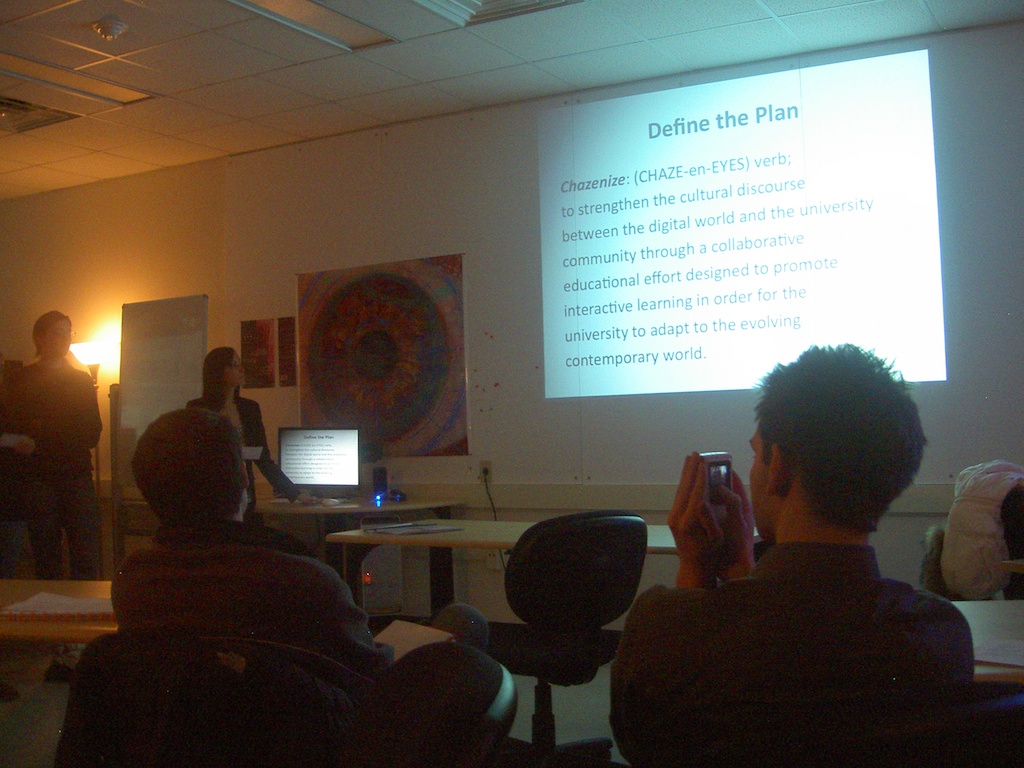
Image of students in media studio.

UW-MADISON


My UW-Madison courses build on the StudioLab pedagogy I first developed at New York University and refined at Dartmouth College, University of the Arts (Philadelphia), and the University of Wisconsin-Milwaukee.

Courses combine critical analysis and creative synthesis and call on students to experiment conceptually, aesthetically, technically, and organizationally.


Smart Media and Critical Information Design

This seminarlab focuses on “smart media” or emerging genres of scholarly communication, such as digital storytelling, theory comix, podcasts, Pecha Kucha, and interactive installations. We approach smart media from two perspectives: 1) exploring their historical and theoretical relation to 20th- and 21st-century experimental texts by such thinkers as Barthes, Benjamin, Deleuze/Guattari, Doxiadis/Papadimitriou, DuPlessis, Hofstadter, Hayles, Latour, Mandelbrot, McLuhan, and Ronell; and 2) experimenting with their aesthetic and technical connections to contemporary information design that rattles the cage between knowledge and action. Honing analytic and practical skills, students work both individually and collaboratively, studying and producing smart media projects based on their own research, as well as materials and issues raised in class. Design theory and artist activist readings include works by Applebaum, Critical Art Ensemble, Crimp, Guerrilla Girls, McCandless, Tufte, Wurman, and Wysocki/Lynch.

Orality, Literacy, Digitality

This seminarlab focuses on three epochal modes of communication—orality, alphabetic literacy, and digital electracy. The shift from the orality of Homeric poetry to the literacy of Platonic philosophy has long been considered the foundation of Western civilization, while the rise of digitality has been proclaimed by some to coincide with the West’s global triumph and by others to help effect its relativization, if not its decline. Our purpose in this course is less to decide this last question than to articulate the continuities and breaks between these different modes of communication both within and outside the Western tradition. The shift from orality to literacy to digitality in the West unfolds over more than two millennia, but for much of the world, alphabetic literacy dates back only a century or two. More striking still: in the twentieth century, some traditionally oral societies became literate and digital in a single generation. Thus while we will study these epochal modes of communication in relation to Western culture, we will also run some interference with this familiar story by studying issues of orality and literacy with respect to selected non-Western cultures. In addition, because the role of numbers has often been ignored by historians of communication, we will also study the importance of numeracy in relation to print and digitality.

Civil Disobedience: From Walden to the Web

This course explores a concise genealogy of civil disobedience, with particular attention to questions of writing, performance, and technology. We begin by considering Etienne La Boétie’s “On Voluntary Servitude” and its later rereading by revolutionary Romantics. Here we see popular dissent emerging in struggles over political authority and human agency. We then turn to modern civil disobedience. Engaging texts and actions by Thoreau, Gandhi, and King, we examine nonviolent resistance to slavery, war, colonialism, and segregation. These readings prepare our central question: how do emerging forms of electronic civil disobedience extend and displace more traditional forms of popular dissent? Here we will study practices of nonviolent resistance that combine performance, social activism, and media. Engaging the work of the Guerrilla Girls, ACT-UP, Operation Rescue, Critical Art Ensemble, and Electronic Disturbance Theater, we will explore the growing importance of media and culture in activist work, including the recent Twitter revolutions in the Mideast. 

Performativity and the Torture Test

This seminar investigates the relation of torture and global performativity, the latter understood as a post-disciplinary formation of power and knowledge that operates through embodied performances and discursive performatives and, on a much broader level, serves as the onto-historical stratum on which unfold such phenomena as postmodernity, postcolonialism, and neoliberal globalization. The seminar’s two goals are to engage critical concepts of performance theory—namely, those of performance, the performative, and performativity—and then use them to examine how discourses and practices of torture operate in the world today. To this end, we will approach contemporary regimes of torture from a historical perspective, examining torture’s long legacy within Western societies, its Enlightenment abolition, and its  “return” in the 20th and 21st centuries.

*/

Version 7.433h

labster8

the secret to theory is a good set of subwoofers