
Dear HAW folks,The video and abstract/script below served as my response to the CFP from the Performance and Philosophy Working Group for PSi (Performance Studies international) #23 in Hamburg this summer. As you can see here the P&P CFP intervenes in the PSi theme of “OverFlow” by exploring a “performance philosophy of the refugee” based on “other ‘overs.'” While I won’t go into the organizational rivalry between PSi and P&P here, my intervention follows certain poststructuralist thinkers (Avital Ronell, in particular) in reading Nietzsche’s Ubermensch as “it’s over, man,” against the grain of Aryan supermen and all-too-human neo/liberal humanisms, by channeling Ubermensch and refugees as going over and under, as Uberoverundunder. If concreteness and pragmatism appear wanting, I am simultaneously developing workshops to help train Cornell students working with LEP (limited English proficiency) refugee communities to translate essential existential information into comic book form, along the lines of graphic history and graphic medicine. I welcome your thoughts on the various strains of transmedia knowledge at work here, the slipperiness between expert and common knowledges, and their risky potential for refugees, performance philosophers and historians of the future.JonFrom Iceland, Iran, the Philippines, Australia, Turkey or the US, more than 800 international scholars and artists will devote their lectures, discussions, workshops, and performances to the metaphoric ambiguity and impact of the word OverFlow. Rather than on notions of shortage and lack, which dominate the current debate, contributions focus the exact opposite: excess will be addressed in all of its positive and negative connotations. CFP: Performance and Philosophy Working Group Even after highlighting the positive and productive connotations of “overflow,” does that word itself not continue to smuggle in a specific worldview or topography? Namely, for overflow to occur, must there not first exist borders over which a given entity can move? Aligned with the flight of refugees, these theoretical borders concretize into national boundaries and frame the conversation of overflow within the language of diplomacy, national governance, and human rights (a term which is itself ensconced within and perpetuated by a particular, state-based discourse). And yet, to cultivate a philosophy of the refugee, one that will provoke a practical engagement with the bodies of the refugees as well as the ideas of migration, shelter, and forced relocation that subtend the movements of those bodies, surely we will have to think beyond and even without the “given” political boundaries drawn on maps and the national identities affixed to pre- and post-flight refugees. “Overflow” does not, then, necessarily provide the best launching pad for such an event, at least not by itself. What about the other “overs”? Overrun, overwrite, overtake (perhaps also its counterpart, unumgänglich, which Anne Carson translates as “overtakelessness”), overcome: each of these terms lead us in different directions. “Overrun” speaks to a swamping, a teaming, a tidal break. “Overwrite” sends the mind to the devious and ingenious art of palimpsest and suggests a hidden text vying with more visible traces. “Overtake” marks the moment at which a balance (maybe a balance of power) shifts. “Overtakelessness” names the insurmountable, that which can’t be got around. “Overcome” limns an emotional moment of breakage and points, perhaps, to the end of an era and the emergence of either the new or the return of the ever-same. This call for proposals places overflow into this constellation and asks participants to flow beyond the boundaries of the overflow thematic and turn our attention to a philosophy of the “over” as it encounters the refugee. Furthermore, participants are asked to expand the semantic domain of the word “refugee” to include an additional etymological dimension. Specifically, you are asked to couple “one who seeks shelter” (i.e., the typical etymology of the word refugee) with “intensified flight” (from the Latinate intensifier re- and the root fugit). Do these two definitions sit well together? Does one deserve more attention than the other? How does this type of nominative investigation influence our thinking of the “over” constellation and the body of the refugee? Gazing at this constellation and considering these linguistic questions, the Performance and Philosophy Working Group will gather in Hamburg for PSi 23 with the intention of deriving a performance philosophy of the refugee. This gathering will function something like a conference in reverse. Instead of bringing readymade papers to the event and presenting pre-formed scholarship, we will select a panel of speakers to hold space together for two sessions in Hamburg, each 3 hours in length. During that time, the panel will work extemporaneously through dialogue, argument, physical exercise, satire, farce, and any other means necessary to produce, collectively, a point of entrance into the philosophy of the refugee tethered to the various “overs” articulated above. After the conference, each panel member and attendee at the events will return home and put thought to paper or some other medium to index the most salient and promising ideas produced at the conference. As a group, we will circulate the index of our thinking to the Working Group and the Performance Philosophy community. To be considered as one of the panel of ten, please prepare a written abstract, a short video, or a sonic composition that can function something like a position statement and a declaration of methodology. With the former, the “statement” should offer a sense of your beliefs regarding the contemporary event of the refugee vis-à-vis the philosophical constellation presented here. With the latter, the “declaration” should explain how a specific approach to this issue might foster a productive conference gathering. If selected to participate in the panel, you must be willing to dedicate six hours of your time at the conference to this undertaking and commit to collating your findings into some kind of shareable media after the event. [….] |
Discargo: Uberoverundunder
Jon McKenzie – October 6, 2016
Abstract/Script
To rethink overflow through the refugee, let us start with a highly charged philosopheme of “over”: Nietzsche’ Ubermencsh, and pose refugee as Ubermensh: not as Aryan superman but under-man or under-human, the dispossessed and migrant, the ones who go overboard in going under: under the border, under the fence, under the ground, under the water, over and under all the overseers, political checkpoints, and conceptual markers of belonging and non-belonging.
If we understand refugees as those seeking shelter but also experiencing the intensity of flight, we find the strangely embodied im/mobility of going under: the refugee’s flight for and from shelter after shelter and the shelter of and from flight after flight. An unsettling intensity of settling, a mobile immobility and immobile mobliity. Bodies swaying here in hopes of staying there and a swaying there in despair of staying here. Going somewhere while going nowhere and vice versa. Going over and under, over and over: the refugee goes Uberoverundunder, overundover.
And refugee as refusée of humanity: precious cargo discarded, thus discargo, persons without the proper card, papers, rights of passage.Yet pass they do, in waves upon waves: bodies in cargo ships and wooden boats, in hidden compartments of semi-trailers, in the wheel wells of transoceanic jets, on foot across borders, rivers, fences and walls. The precious cargo of discargo, waves upon waves, sometimes going over, sometimes going under, the unsettling of settling in or up or down.
Jon McKenzie – March 13, 2017
Title(s): I note some productive slippage between the title “Philosophy of the Refugee” and “philosophies of the refugee” in Will’s first question. I wonder if the slipperiness could increase with “philosophies of refugees,” as well as differentiating while blurring “philosophy/ies about refugees” and “refugees’ philosophy/ies,” i.e. refugees’ own philosophies or philosophizing. To put things bluntly, are we trying to articulate a proper Philosophy of the Refugee or open up possibilities of potentially improper refugees’ philosophies? Both/and?
Going under: might philosophy have different meanings and uses for refugees and philosophers? What of refugee philosophers or philosophizing refugees? A philosopher (e.g., Derrida, exiled from Algeria, reading Heidegger, at home in Germany) might call attention to the role of such oppositions as home/not at home, property/propertyless, propriety/impropriety, (ap)propriation/ex(ap)propriation, belonging/not belonging, authenticity/inauthenticity, clean/unclean within the history of philosophy and refugees’ own discourses. Slipperiness between episteme and doxa, expert and common knowledge, dialectics and mimesis, medicine and poison. Pharmakon as rhyming dope ruining dialectical thought.
What going under might mean for refugees, philosophers, refugee philosophers, philosophizing refugees. Socrates as pharmakos (scapegoat): sentenced to exile or death, he choses the hemlock. Benjamin on the border, Adorno and Marcuse in California. Self exiled in Turin, Nietzsche sees a horse being beaten in the late 19th century. In the early 21st, over 100 refugee and immigrant communities beat it to Buffalo, New York. Rhyming across times and sites is disastronautics, minor onto-historigraphies, spacetime travel.
Discargo: Trump and the precious cargo of discargo, persons without the proper card, papers, rights of passage. Executive Order “Enhancing Public Safety in the Interior of the United States” states “Sanctuary jurisdictions across the United States willfully violate Federal law in an attempt to shield aliens from removal from the United States.” In response, official and unofficial sanctuary cities face defunding and brace as ICE officers target undocumented immigrants and refugees, while campuses nationwide declare or debate their status as sanctuary campuses, with at least eight state legislatures countering with legislation against such campuses.
Since 2003, Buffalo has welcomed refugees and immigrants, creating social services, housing, and LEP (Limited English Proficiency) classes. These efforts have been driven by humanitarian and urban development concerns: as a response to sharp population decline due to loss of industries, Buffalo has opened its doors, and its refugee population has doubled with arrivals from Bhutan, DR Congo, Iraq, Myanmar, Somalia, and, most recently, Syria. Now facing Trumpism, the potential of losing Federal funding, and ongoing attacks from right-wing critics over its policies, Buffalo Mayor Byron Brown walks the high wire writing:
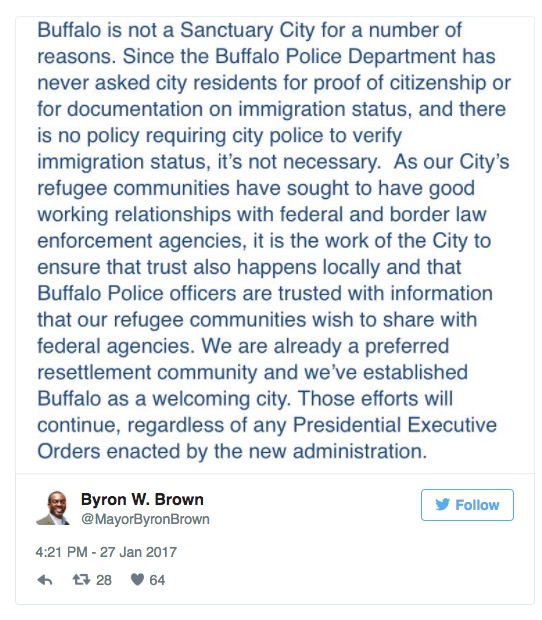
Meanwhile, safe houses open in Buffalo as part of a new Underground Railroad to Canada.
Questions:
• Can Buffalo’s successful initiatives and current efforts, as well as those of sanctuary campuses, survive Trumpism, and if so, how?
• How might performance philosophy mix episteme and doxa, proper and improper, philosophers and refugees?
• What might community-based participatory research with Buffalo’s immigrant and refugee communities offer performance philosophy?
• Rhyme overunder reason?